






Which setting should you choose? Which diamond ring is right for you? Which diamond setting is the most elegant and timeless? Selecting the right jewelry, such as an engagement ring, a pair of earrings, or a necklace, isn't always easy. Today, you can choose from a variety of precious metals, diamond cuts and shapes, and settings. Unfortunately, this last point is too often overlooked. Yet, the setting is what gives the jewelry its beauty by highlighting the gemstone. That's why, in the rest of this article, we'll present the different types of diamond settings so you can make the right choice.
Setting a piece of jewelry means securing a precious or semi-precious stone to a precious metal. This process is called setting. For example, a jeweler can set a diamond in a gold ring. You can also find watches with diamond-set dials, like our white Chanel women's watch. It's important to know that there are different types of settings.
Each setting has its own effect on the final look of the piece. But each diamond setting also has advantages and disadvantages regarding the protection of the gemstone and ease of care.
When choosing a ring, you don't have to limit yourself to solitaire rings, those with a single diamond. You can also opt for a ring with two gemstones, or even a ring with three. Setting is also very important for other types of jewelry.
Different diamond settings mean different looks. A tension setting, for example, has a unique appearance because the diamond seems to float. The prong setting, on the other hand, is a classic style primarily used for solitaire rings to showcase the diamond's brilliance. The diamond's shape will also influence the type of setting. For example, a pear-shaped diamond will stand out best in a bezel or prong setting. In the world of jewelry, there are many settings, but below we'll introduce you to some of the most popular:
Of all the diamond setting styles, the prong setting is the most popular. The diamond is mounted on the band of the ring with three to ten prongs. However, a prong setting with four or six prongs is usually preferred. Because the gemstone isn't completely surrounded by precious metal, it can reflect a lot of light, but it's also more susceptible to dirt and dust. Although the diamond is fully visible, this type of setting holds it securely in place. Prong settings aren't only used for rings; they also work beautifully with other jewelry such as earrings.
With a halo setting, diamonds are placed around the center diamond. The halo setting is used on engagement rings because the center diamond appears much larger than it actually is. In addition to engagement rings, the halo setting looks beautiful on earrings. With this setting, it is also easy to replace a colorless center diamond with a colored gemstone, such as a sapphire.
The bezel setting is one of the most secure diamond settings, as the diamond is completely enclosed within a thin band of metal. This is why it is also one of the most suitable diamond settings for jewelry you intend to wear every day. The diamond is fully protected from external factors and appears larger to the naked eye because the precious metal reflects its brilliance even more.
A semi-bezel setting allows more light to pass through the gemstone, so the piece will sparkle a little more than with a bezel setting. However, the diamond will be more fragile and susceptible to damage because it is more exposed
The cathedral setting lives up to its name. The diamond is held in place by precious metal arches, so it rises above the rest of the ring like a Gothic cathedral. The difference in height makes the center stone appear larger, resulting in a truly impressive piece of jewelry. However, it's more prone to snagging on clothing, hair, or other fabrics, making this setting less suitable for everyday wear. You'll also spend a bit more time cleaning this ring.
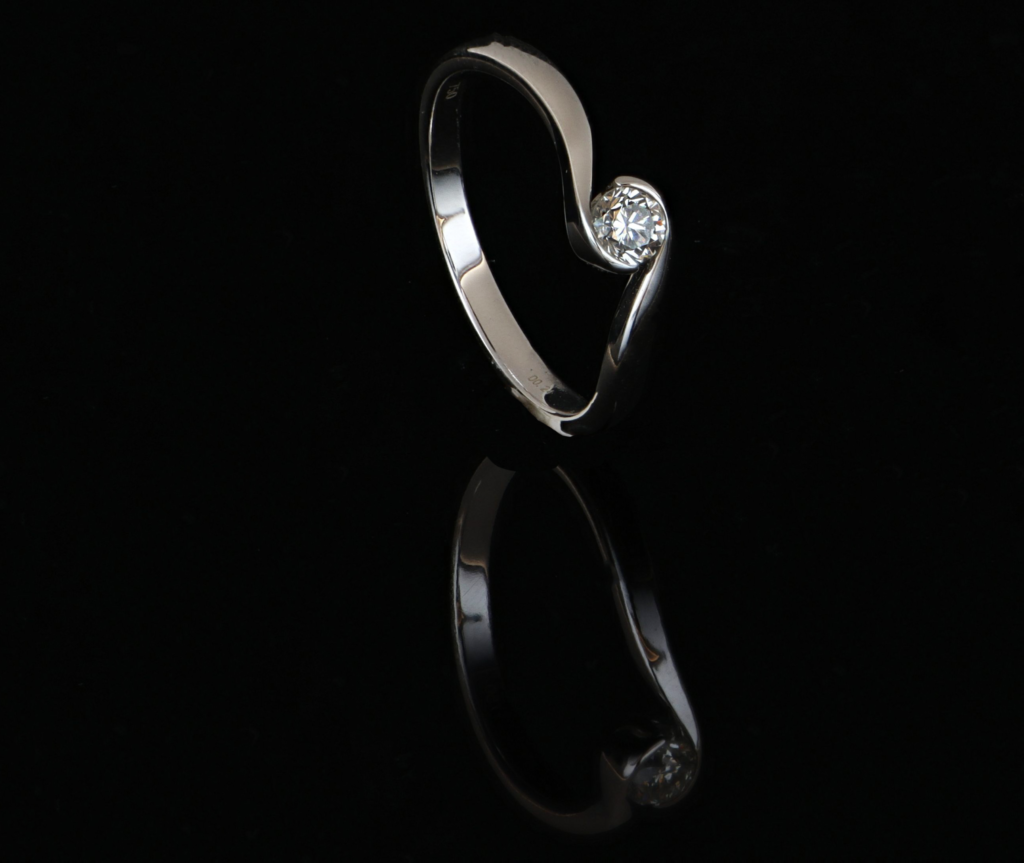
Of all diamond settings, the tension setting is the most unique. Here, the diamond is held in place by the pressure of the band. This gives the impression that the gem is floating. Needless to say, this technique requires precision and expertise. With the tension setting, the diamond captures light and reflects it from all sides with greater intensity.
A channel setting is a setting where many small diamonds are placed side by side. The stones are set in channels constructed from metal rails, ensuring a simple and elegant look.
The shared prong setting is the same as the prong setting, except that multiple diamonds are held using the same prongs. Unlike the channel setting, the shared prong setting allows more light to pass through the diamonds, making them appear brighter. However, the diamonds are also more susceptible to damage, and more dust and dirt will accumulate on the jewelry.
The bar setting is a variation of the channel setting. The gemstones are secured between two parallel bands of precious metal, so they are recessed and only the top portion is visible. The outer surface of the ring is relatively flat and therefore more secure. This setting can be used on all types of jewelry.
Pave setting evokes a pavé effect. Several small diamonds are arranged side by side and held in place by tiny, pearl-like prongs. These prongs are milled directly into the metal, leaving virtually no precious metal visible. The effect is reminiscent of small pavé stones, hence the name. Pave setting is very popular with more traditional couples and looks beautiful in combination with a brilliant-cut center diamond or a princess cut.
The French pavé setting is a variation of the standard pavé setting. However, it is more elegant and refined. The gemstones are set in a V-shaped slot, and small pearls are visible at the points. As a result, the piece of jewelry is even more brilliant.
You now have a better overview of the different types of settings. If you would like to learn more about diamond settings, feel free to visit our online jewelry store. There you will find unique creations such as Franche-Comté watches, as well as plenty of advice for choosing your jewelry.